Bachelor of Design (Games)

Bachelor of Design (Games)

UNDERGRADUATE
Study load
Full time
Program code

BP214

Duration
3 years
Application deadlines

05 Feb 2027
08 Oct 2027

Intakes
Mar, Oct
Location
RMIT Saigon South
Program code
N/A
Application deadlines
N/A

Overview

  • Learn to design and create games across physical, digital and emerging interactive formats 
  • Develop a creative and strategic mindset to innovate gameplay for global markets, leveraging Vietnam's cultural insights for international impact 
  • Build work-ready skills and a professional portfolio through studio projects, interdisciplinary teamwork and industry-standard tools and facilities

Games are more than entertainment. They are interactive systems, stories, challenges and experiences shaped by how people play. The Bachelor of Design (Games) is for students who want to create meaningful games across digital and analogue formats, from early concepts and prototypes to polished, playable outcomes.  

Students learn to design mechanics and levels, build narratives, develop game systems, balance gameplay and explore game art and programming. With studio learning central to the degree, they learn by making: prototyping, playtesting and developing original games in collaborative team environments that reflect contemporary industry practice. 

Alongside creative and technical practice, students strengthen their critical thinking, research and reflective skills to become thoughtful, adaptable designers. They also explore emerging AI tools and workflows, learning to work creatively and responsibly as games and interactive media continue to evolve. 

With guidance from academic staff and industry experts, access to state-of-the-art facilities and industry-standard software, and opportunities to complete a capstone project or internship, students build a portfolio that demonstrates their creative voice, design process and readiness for games and interactive media careers.

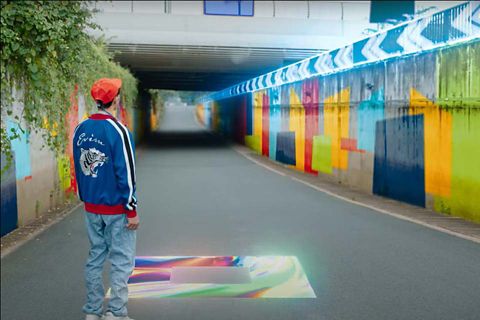
 a male student standing on a street filled with graphics and colours

Program structure

The structure displayed shows the advised program structure and progression. 

Semester 4

Semester 5

Semester 6

Semester 7

Semester 8

Semester 9

(***): Capstone Project

*University elective: Students can choose from elective courses offered across the university in any program.

**Game Design Studio: Students create their own game projects in a collaborative environment. From board games to video games, they develop concepts, build prototypes, test gameplay and refine their work through feedback. These projects become valuable additions to each student’s creative portfolio.

Program guide for RMIT Saigon South.

Learning, teaching and assessment

  • The program uses a variety of learning and teaching approaches which may include lectures, tutorials, workshops, seminars, studio practice, problem-based learning, reflective techniques e.g. blogs, online and face-to-face presentations, group-based learning, online and face-to-face discussions, and negotiated learning for a major project
  • The overall approach to assessment in the program combines assignments, portfolio production, presentations, and peer or industry review. Where appropriate, research projects and presentations are directly related to industry specific outcomes and may culminate in public showings or online outcomes

These program learning outcomes have been developed in consultation with creative leaders across the games and entertainment industries with a view to foster that same creative leadership in graduates. 

Upon the successful completion of this program, you will be able to:

  1. Apply game design production methods, in both individual and group capacities, to solve creatively generated problems.
  2. Develop a technical and conceptual portfolio relevant to game art and design and other forms of interactive entertainment.
  3. Apply a body of conceptual and practical knowledge, and design skills, to address other forms of media and communication.
  4. Critically analyse how games and play have specific local and global contexts.
  5. Demonstrate creativity, critical thinking and innovation when identifying and solving problems in and around game design and production.
  6. Communicate using diverse formats and strategies to audiences within and external to game design.
  7. Work with others in a range of roles and contexts, demonstrating cultural, environmental and social awareness and ethical and reflective practice.

RMIT provides world-class blended learning with both face-to-face and online experiences in a global network, a supportive community, and real-world skills.

Career

Graduates can pursue creative, technical and production roles across games, interactive media, entertainment, education and emerging digital experiences. 

  • Game designer  
  • Game developer 
  • Level designer 
  • Narrative designer 
  • Game writer 
  • Game producer  
  • Creative director  
  • Game production manager 
  • Game artist (2D or 3D) 
  • Researcher or academic career (Games and Interactive Media) 

Further studies

When you successfully complete this program, you may be eligible for entry into an RMIT honours or postgraduate program in Vietnam and Australia.

Fees

Payments can be made each semester, on a course-by-course basis.

Fee program

Annual tuition fee 

(based on full time study load - 8 courses)

Whole program fee

(24 courses - 288 credits)


15,104 USD (indicative USD fee) ~ 394,656,000 VND 45,311 USD (indicative USD fee) ~ 1,183,968,000 VND 

Notes

    1. RMIT Vietnam has 3 semesters per year, in each semester you enrol into a maximum of 3 courses. The duration of programs is flexible and can be adapted on an individual basis upon enrolment. 
    2. Program fees are priced and invoiced in Vietnamese Dong (VND) by semester. Payments are made each semester, on a course-by-course basis.
    3. Payments made in foreign currencies will be converted to Vietnamese Dong (VND) based on the applicable exchange rate on the transaction date. Any currency conversion fees and related bank charges will be borne by the student.
    4. Online payment via myRMIT is the preferred payment method, as it offers secure transactions, automatic confirmation, and faster processing.
    5. Fees are indicative only and subject to change based on individual enrolment. These fees apply only to 2027. For further details and terms and conditions, refer to the 2027 Student Fees and Charges Guide (available in 2027).

    Scholarships

    Check your eligibility for a scholarship

    We have awarded more than 665 billion VND worth of scholarships to over 2,050 young people from Vietnam and around the world. These people exemplify characteristics that RMIT prides itself on.

    Entry requirements and admissions

    Academic requirements

    • Completion of Vietnamese Upper Secondary School (High School) Graduation Diploma; and
    • Achieve a minimum GPA of 7.0/10.0 for Grade 12

    For other international qualifications please review entry requirements by country.

    Academic pathway

      English requirements

      Successfully complete RMIT Vietnam English Advanced, or complete one of the following English proficiency tests:

      • IELTS (Academic) 6.5 (no band below 6.0)
      • TOEFL iBT 79 (with minimum score of 13 in Reading, 12 in Listening, 18 in Speaking and 21 in Writing)
      • Pearson Test of English (Academic) 58 (no communication band below 50)
      • C1 Advanced (formerly known as Cambridge English: Advanced (CAE)) or C2 Proficiency (formerly known as Cambridge English: Proficiency (CPE)) 176 (no less than 169 in any component)

      For other recognised English results, please view English equivalency requirements.

      Note:

      Previous study and proficiency tests are recognised for two years from the completion date or test date to the program commencement date unless stated otherwise. RMIT does not accept scores from at-home or online testing.

      Where you have achieved more than one form of English language proficiency only the most relevant achievement will be considered in the admission decision.

      Please contact the RMIT Vietnam Student Recruitment team for more information.

      Each selection task will be considered as part of the selection process. The following information is used to help us evaluate whether you have the necessary qualities to undertake our program. 

      Please note that this selection task is retained as part of official RMIT records. Selection tasks will not be returned to applicants. If you wish to retain a record of your work, please make a copy for yourself. 

      You will be required to complete one of the following briefs. 

      Each brief response should take you approximately 1 day, or 7 hours, to complete.  

      You can use and build upon your own pre-existing writing and creative work, such as work completed in high school, or for your own hobbies and passions. The work can also be created purely for this application.  

      Although Generative Artificial Intelligence (AI) is considered a contemporary tool that may be included in your game's education at RMIT, we ask that for these submissions you do not use AI and instead submit an individually authored response. 

      Technical and submission guidelines

      • Format: The selection task response is to be submitted as a single PDF file in A4 size. Multiple pages are acceptable. 
      • Orientation: Portrait orientation is recommended for writing-focused tasks and landscape for art-focused tasks. 
      • File Size: Please try to keep your PDF under 20MB, you might use Adobe Acrobat to compress the size after assembling your work, especially if you’re including high-resolution media. 
      • Demonstrating Gameplay: If you wish to demonstrate gameplay, please create a video or screen recording, host it online (for example YouTube or Vimeo), and include a clear link to the video in your PDF document. Support the link with an image representation (for example a screenshot or thumbnail). 
      • Link Accessibility: If you are submitting online materials ensure they can be publicly accessed (for example "Unlisted" or "Public" for a YouTube video). 
      • Submission: Submit your brief by uploading it to your online application. 

      Submit a folio of 3 to 7 pages that showcases any creative media or design work that you have completed in your final two years of high school study, or examples from recent personal or professional projects. Each work should be annotated, focusing on how your technical skills and creative thinking might translate for a game art, design, or development context. 

      • Include a short introductory statement (100-200 words), highlighting your creative interests and explaining how you foresee your current creative practice translating into a game’s context. 
      • Provide high quality media of creative projects, including but not limited to digital images; scans or photography of non-digital materials; links to video or interactive material hosted online (ensure links are professionally presented and are accompanied by supporting screenshots and documentation). 
      • Provide evidence of your creative process by including work-in-progress such as sketches, storyboards, early-prototypes, photographs of public presentations or audience interactions. 
      • Annotate each work (100-200 words per project). Briefly describe the work, acknowledge the medium, tools, or processes involved in making it, explain your intention for it, and reflect on any feedback you received on it. 

      Using between 500 and 800 words in total, cover the following: (address each point below in a separate paragraph with the appropriate headings).

      • Game Overview: Describe a game you play and what design elements you like or dislike. The game in question can be digital or non-digital.  
      • Suggested Improvements: Critically describe positive improvements you would make to the mechanics of the game and how you would implement them. 
      • Design Impact: Describe the general impact of such improvements and provide a rationale for why they are appropriate. 
      • Cultural Impact: Describe how seeing these improvements might affect the game genre, culture of players, or the game’s industry more broadly.  
      • Include images/drawings/diagrams throughout to illustrate your suggested changes. 

      Construct a folio of your own creative work between 3 and 7 pages, covering the following: 

      • A short description of this world and its context (200 words maximum).  
      • Designs/concepts of a fictional world/environment you would like to see in a game.  
      • Designs/concepts of characters that would inhabit that world.  
      • The focus can be on level design and be more technical or be more art focused. A mood board or references to similar games can be included, ensuring they are properly credited. 
      • Include evidence of your artistic or work process: initial  drawings/sketches/roughs, related work and research, brainstorming, etc. 

      Using between 500 and 800 words in total, cover the following: (address each point below in a separate paragraph using the following headings)  

      • Context and Background: Describe a fictional world you would like to see in a game, and acknowledge if you’re inspired by any existing worlds or genres. 
      • Narrative and Gameplay Structure: what kind of narrative and gameplay design structure would be suited to the world you are proposing. Describe the plot or progression that players would see unfold in the game.  
      • Narrative Experience: Describe how the narrative will be experienced by players through in-game elements such as interactions/mechanics, game environment, or game loop.  
      • In-Game Examples: Written samples of dialogue, narration, or character backstories that would appear in the game. 
      • Include simple drawings/diagrams or reference images throughout to illustrate your world, such as drawings of characters and/or scenes, diagrams of narrative structures. 

      Submit a folio of between 3 and 7 pages showcasing a modding project you have undertaken for a game:  

      • Provide a short summary (max 200 words) of the aim of the mod, and what it included that the original game did not feature.  
      • Include screenshots and/or video of the mod as it features in the game and gameplay.  
      • Include evidence of the process you undertook to create the mod, such as images of the process of modelling different objects and the components of the mod, or any sketches and concepts.   
      • Describe any scripting, coding, programming and how it was implemented, if relevant.  
      • Include any evidence of community feedback, discussion and iteration of your mod, if available, and describe how you have responded to it or improved your mod based on that feedback.

      Submit a folio of between 3 and 7 pages showcasing a game you have designed, prototyped, or made some progress on:   

      • Provide a short summary (max 200 words) of the aim of your design, the method of making it, and the experience you want players to have playing it.  
      • It can demonstrate one or more specific elements of functionality you have worked on.  
      • It can be digital or non-digital (such as a card game or game for physical activity).  
      • Include screenshots/photos and/or video of the game, featuring any interactivity.  
      • Work can be demonstrated through paper-based, sketched, or digital prototypes. 
      • Include evidence of your work process: initial drawings/sketches, brainstorm, screenshots, etc.  
      • Include captions explaining the intention behind your documentation. 

      There are no prerequisite subjects required for entry into this qualification.

      English Pathways

      Don't meet the English language test scores? Successfully complete English for University for entry into this program. 

      Credit transfer

      Come from a partner institution? RMIT has pathway arrangements with many partner institutions around the world. If your institution has a pathway arrangement with RMIT, you may be able to receive credit and reduce the time it will take to complete your preferred RMIT program. 

      Find out if your institution has a pathway arrangement with RMIT.

      If you have qualifications from an institution that is not an RMIT partner, credit into your RMIT program will be assessed on a case-by-case basis.

      Please contact the RMIT Vietnam Student Recruitment team for more information.

      This course is not available for international students intending to study on a student visa.

      Information for international students

      Sorry, this course is not available for international students intending to study on a student visa. If you hold a different visa type, you may be eligible. Please contact Study@RMIT for more information.


      Information for local students

      If you are a local student please select 'switch to local' below to view the full course information.