

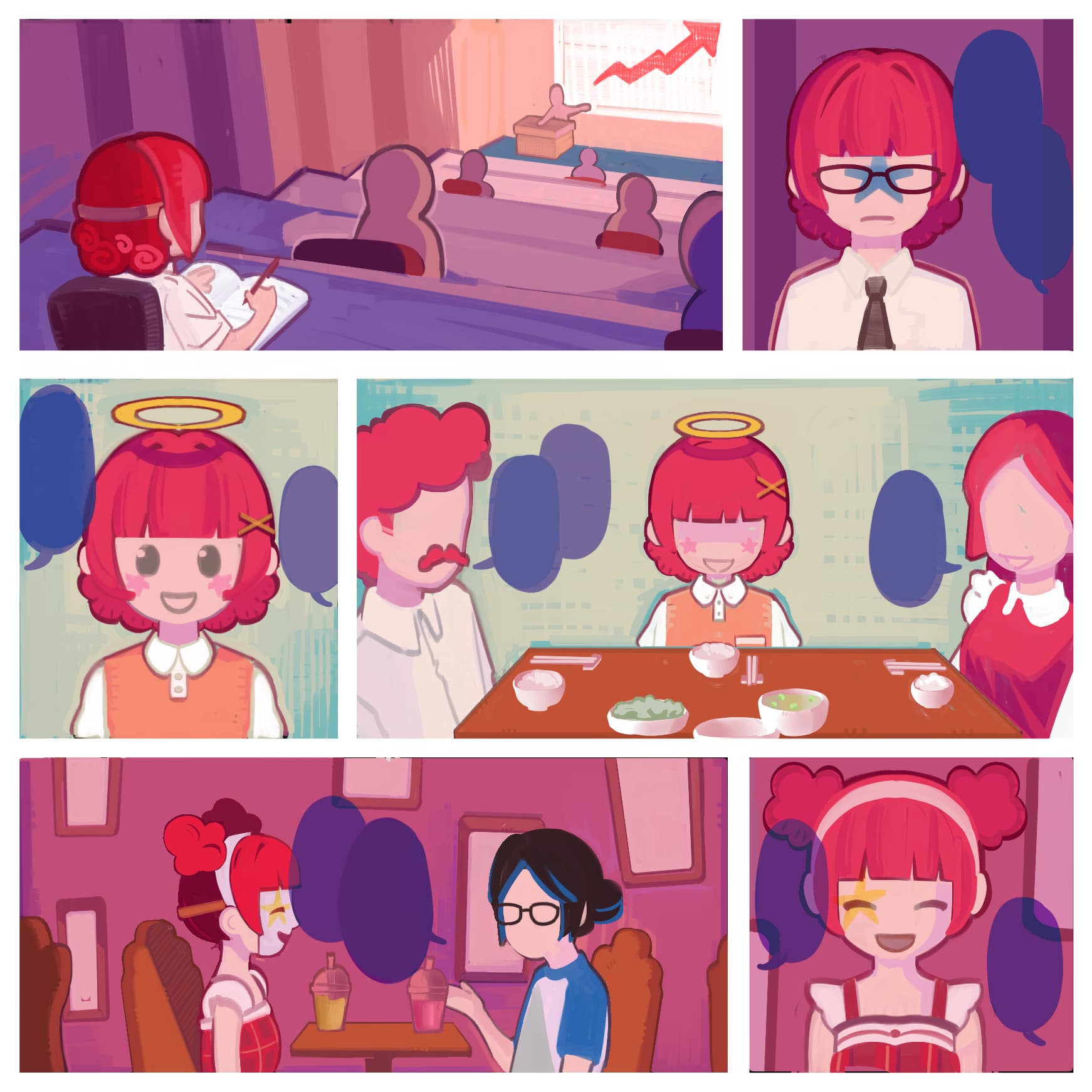


Between who you are and who you are seen to be

Between who you are and who you are seen to be

Every day, we see ourselves through the eyes of others: through reactions, expectations, and subtle social cues. Over time, these reflections begin to shape not just how we present ourselves, but how we think and feel about who we are. This piece explores how external judgments become internal voices, and how students gradually learn to navigate, question, and reclaim their sense of self.

I remember sitting in class, as the lecturer paused after asking a question, a few voices inside me began to respond, replaying a sentence in my head over and over, only for me to decide not to say it. It wasn’t that I wanted to contribute, but the quiet fear of how I might sound and how that version of me would be judged. As this kept happening, I started questioning why that imagined reaction felt so real even before I spoke. Slowly, I realised something unsettling: 

I didn’t just exist as I was – I started to see myself through how I imagined others would see and judge me.

Myself through the Looking-glass

In structured spaces like classrooms, where this tension shows up clearly, I find myself becoming hyper-aware of being evaluated. I find myself holding back opinions, softening my tone, or choosing safer answers because I’m already anticipating judgment for the “real me” that doesn’t feel adequate. Looking at it more closely, this reflects the 𝗟𝗼𝗼𝗸𝗶𝗻𝗴-𝗚𝗹𝗮𝘀𝘀 𝗦𝗲𝗹𝗳, a term coined by Cooley in 1902, where the sense of self is formed through imagining how others perceive me, interpreting their judgments, and internalizing them. In my case, I’m not just responding to the situation itself, but to a version of myself that exists in other people’s minds.

At the same time, being in early adulthood means I’m still exploring who I am while being under pressure to present a stable and confident identity – one that appears certain, articulate, and capable in academic discussions, especially in an environment where participation and critical thinking are highly visible and often implicitly expected. This makes the pressure I feel even more intense.

Internalising judgments (Image provided by author)

The campus highlight reel

Not only on campus, but I also noticed that this pattern becomes even more visible in the context of my student life, particularly on social media, where self-presentation feels more deliberate. When I scroll, I notice how content is rarely random – it’s made up of carefully selected moments, from group project updates to campus hangouts or late-night study stories – and all are carefully shaped to portray identities of hard-working, academically thriving students. In responding to them, whether through likes, comments, or silent comparisons, I also become part of that process. Without realising it, we begin to shape each other’s perceptions, creating a cycle where everyone is both performing and responding at the same time. In that sense, self-presentation becomes less about individual choice and more about a shared, ongoing construction of how we are seen. 

Social chameleon effect

Over time, I have become increasingly aware of how I shift across different situations. It appears in subtle but uneasy moments, such as being more expressive with close friends yet noticeably quieter in class, or feeling confident in an idea when alone but second-guessing it the moment I anticipate others’ reactions.

Becoming different versions of myself in different contexts (Image provided by author)

This inconsistency is shaped by ongoing interactions, classroom dynamics, and shared experiences within the learning environment at RMIT University – for instance, during a club meeting where open discussion is encouraged, yet I still find myself hesitating before speaking. What stands out is how naturally these adjustments occur. It doesn't feel like an explicit choice; on the other hand, aligning with what feels socially acceptable or expected feels natural. This raises a deeper question of whether the way I present myself reflects my actual thoughts, or if choosing “safer expressions” has become a habit. Becoming aware of this tension is what allows me to move toward more intentional and self-aligned responses.

Taking back my control

Ideas discussion during a club’s meeting (Image provided by author)

My awareness started from where the pressure started: in situations like group discussions or class participation at my university. Instead of automatically adjusting, I try to pause and ask myself a simple question: Am I choosing to adapt here, or am I afraid of being judged if I don’t? In high-performance classroom settings, I tend to adapt more readily to expectations. In contrast, smaller environments like club meetings allow me to speak more openly, as familiarity lowers the pressure and makes it easier to act in alignment with myself. In other contexts, I try to stay closer to what feels true to me, like speaking up even if it’s imperfect. These small decisions don’t remove the gap entirely, but they make it feel more manageable, like I have a say in how I show up.

Conclusion

The tension between my private and perceived self is no longer something I try to eliminate because I’ve come to understand that it is part of how my identity develops. What has changed is how I respond to it. The everyday interactions I experience at RMIT – whether in classrooms, group work, or social spaces – act as pieces of an unfolding puzzle, each adding to how I see myself over time. What has changed is how I respond to this process. 

With more awareness, I start making intentional choices. Instead of only posting polished content, I sometimes share thoughts that feel more genuine than perfect. In group work, I contribute earlier rather than waiting until my ideas feel “good enough”, while in social settings, I allow myself to be less filtered. These shifts don’t remove the gap, but make it more manageable. Maybe next time I hesitate in class, it won’t just be fear – it will be a choice, and that choice itself reflects something closer to who I really am.

References  

Cooley, C. H. (1902). Human nature and the social order. Charles Scribner's Sons.

If you're interested in this topic, visit Mind Club's fanpage, where we are exploring it through social media posts and upcoming activities. Follow us to be updated! 

Story: RMIT Mind Club. This article does not reflect the views of RMIT Vietnam as an institution.

16 April 2026

Share

More news