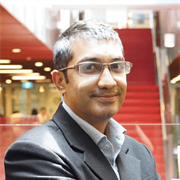
Ronald Kumar
Details
 College: The Business School
 Department: The Business School
 Campus: Saigon South Campus Vietnam
 ronald.kumar@rmit.edu.vn


Open to
- Masters Research or PhD student supervision
About
Biography
Dr. Ronald Kumar is a Senior Lecturer in Economics at RMIT University Vietnam. He brings more than a decade of academic, research, and industry experience across economics, finance, and development studies.
Prior to joining RMIT University Vietnam, Dr. Kumar served at the University of the South Pacific (USP), Fiji, for over ten years, progressing through a range of academic leadership roles including Associate Professor, Senior Lecturer, Lecturer, and Adviser for the Banking and Finance Program within the School of Accounting and Finance. He began his academic career in 2011 as a Teaching Assistant in the School of Economics at USP, where he taught courses in microeconomics, macroeconomics, economic statistics, and development economics before transitioning to finance and banking education.
Before entering academia, Dr. Kumar worked as an Economist at the Reserve Bank of Fiji and as a Project Analyst with ANZ Pacific Operations. From January 2019 to May 2022, he served as Associate Professor in the School of Accounting and Finance at USP, contributing significantly to teaching, research, curriculum development, and postgraduate supervision.
Teaching
Dr. Kumar has extensive teaching and course coordination experience across economics, finance, and banking disciplines. His teaching portfolio includes:
Economics
- Microeconomics
- Macroeconomics
- Business Statistics
- Development Economics
Finance
- Financial Mathematics
- Investment Analysis
- International Finance
- Corporate Finance
- Development Finance
Banking
- Banking Management
His teaching philosophy emphasizes analytical thinking, practical application of economic and financial theory, and evidence-based decision-making in contemporary business and policy environments.
Research
Dr. Kumar's research lies at the intersection of economics, finance, and development studies. His work explores the drivers of economic growth and development, with a particular focus on developing economies and small states. Drawing on both theoretical and empirical approaches, his research is strongly informed by contemporary growth theories and development economics.
His major research interests include:
Tourism Economics
Research examining the economic impacts of tourism development, sustainability, and tourism-led growth.
Selected publication outlets:Tourism Management, Tourism Economics, Tourism Management Perspectives, Tourism Analysis, Applied Economics, Social Indicators Research, Metroeconomica, Economies, and Journal of Asia Pacific Economy.
Migration and Remittances
Research focusing on labour mobility, remittance flows, and their implications for economic development.
Selected publication outlets:Quality & Quantity, Economic Systems, International Migration, Applied Economics, African Journal of Economic and Sustainable Development, and International Review of Economics.
Energy and Economic Growth
Research investigating the relationship between energy consumption, renewable energy, and economic development.
Selected publication outlets:Renewable and Sustainable Energy Reviews, Energy Policy, and Journal of Oil, Gas and Coal Technology.
Technology, Innovation, and Economic Development
Research exploring digitalization, technological advancement, innovation, and productivity growth.
Selected publication outlets:Telecommunications Policy, Economic Change and Restructuring, and Quality & Quantity.
Peace Economics
Research examining the economic dimensions of conflict, peacebuilding, and social stability.
Selected publication outlets:Defence and Peace Economics, Journal of Economic Studies, and Singapore Economic Review.
Pensions and Demographic Economics
Research focused on population ageing, pension systems, demographic transitions, and economic sustainability.
Selected publication outlets:Journal of Pension Economics and Finance, Metroeconomica, and Panoeconomicus.
Investment and Banking Sector Analysis
Research related to financial markets, banking performance, risk management, and investment behaviour.
Selected publication outlets:Journal of Risk and Financial Management, Accounting Research Journal, Risks, PLOS ONE, Quality & Quantity, and Physica A.
Market Structure and Macroeconomics
Research examining competition, industrial structure, and macroeconomic performance.
Selected publication outlets:Annals of Economics and Finance, Metroeconomica, Sustainability, Journal of Economics, and Bulletin of Economic Research.
As of January 2026, Dr. Kumar's research impact is reflected in an h-index of 24 on Scopus and 35 on Google Scholar, demonstrating a strong international scholarly presence across economics and finance disciplines.
Professional Service and Memberships
Dr. Kumar is actively engaged in the international academic community through editorial leadership, professional memberships, and scholarly service.
Professional Memberships
- Member, Post Keynesian Economics Society (since 2024)
- Member, Australian Economic Society (since 2024)
- Regular Member, CFA Institute (2021-2025)
Editorial and Academic Service
- Editorial Board Member, Green Finance (AIMS Press), 2019-present
- Guest Editor, Journal of Risk and Financial Management (2019-present)
- Guest Editor, Special Issue on Financial Development and Economic Growth, Journal of Risk and Financial Management (2020-2022)
- Guest Editor, Sustainability (2019-2020)
- Associate Editor, Journal of Pacific Studies, University of the South Pacific, Fiji (2018-2020)
Through his research, teaching, and professional engagement, Dr. Kumar contributes to advancing knowledge in economics, finance, and development, with particular emphasis on policy-relevant research for developing economies and small island states.

UN sustainable development goals
- 8 Decent Work and Economic Growth
- 12 Responsible Consumption and Production
- 10 Reduced Inequalities

Academic positions
- Senior Lecturer
- RMIT Vietnam
- The Business School
- Ho Chi Minh City, Vietnam
- Jun 2022 – Present
- Associate Professor
- University of the South Pacific
- School of Accounting, Finance and Economics
- Suva, Fiji
- Jan 2019 – May 2022
- Associate Dean – Research & Postgraduate Affairs
- University of the South Pacific
- Faculty of Business & Economics
- Suva, Fiji
- Aug 2018 – Dec 2019
- Acting Head
- University of the South Pacific
- School of Accounting and Finance
- Suva, Fiji
- Jul 2018 – Aug 2018
- Lecturer
- University of the South Pacific
- School of Accounting and Finance
- Suva, Fiji
- Jul 2016 – Aug 2016
- Senior Lecturer & Advisor for Banking and Finance Program
- University of the South Pacific
- School of Accounting & Finance
- Suva, Fiji
- Oct 2016 – Dec 2018
- Assistant Lecturer
- University of the South Pacific
- School of Accounting & Finance
- Suva, Fiji
- Aug 2013 – Jul 2016
- Teaching Assistant
- University of the South Pacific
- School of Economics
- Suva, Fiji
- Jul 2011 – Jul 2013
- Part-Time Tutor/ Lecturer (Math)
- University of the South Pacific
- School of Foundation Studies
- Suva, Fiji
- Feb 2005 – Apr 2005

Non-academic positions
- Economic Planning Officer
- Ministry of National Planning, Government of Fiji
- Fiji
- Apr 2011 – Jun 2011
- Economist- Policy & Research
- Reserve Bank of Fiji, Policy & Research Department
- Fiji
- Feb 2005 – Apr 2005
- Project/Business Analyst
- ANZ Operations, Project and Governance
- Fiji
- Dec 2005 – Mar 2007

Supervisor projects
- Demographic-Driven Development Finance in an Interconnected World
- 16 Oct 2026
- A Multi-Level Exploration Of Sustainability Reporting Practice Variations Among Vietnamese Listed Firms: The Interplay Of Insitutional Logics And Managerial Habitus
- 11 Feb 2025

Teaching interests
Dr. Ronald Kumar has extensive teaching experience across economics, finance, banking, and business disciplines at both undergraduate and postgraduate levels. At RMIT University Vietnam, he teaches courses including Business in the Globalised Economy (International Trade), Diverse Perspectives in the World Economy, Managerial and Business Economics (Intermediate Microeconomics), and Macroeconomics I. Prior to joining RMIT, he taught and coordinated a broad portfolio of courses in economics and finance, including Mathematics of Finance, Investment Analysis, International Finance, Corporate Finance, and Banking Management.
In addition to teaching, Dr. Kumar has played an active role in curriculum design, program development, and academic quality assurance. During his tenure at the University of the South Pacific, he contributed to the development and review of economics, finance, and banking curricula, ensuring alignment with evolving industry requirements and international academic standards. He has been involved in course redesign initiatives, assessment development, accreditation processes, and program enhancement activities aimed at improving student learning outcomes and graduate employability. His teaching philosophy combines rigorous theoretical foundations with practical, real-world applications, fostering critical thinking, analytical reasoning, and evidence-based decision-making among students from diverse academic and cultural backgrounds.

