
Are you using AI as an assistant or a collaborator?

Are you using AI as an assistant or a collaborator?

Many knowledge workers use AI as an assistant, but RMIT Vietnam research suggests they can gain more value by engaging AI as a collaborator that challenges ideas, tests assumptions, and expands perspectives.

You may be using AI every day. But how are you using it?

Do you ask it to summarise documents, draft emails, or rewrite presentations?

Or do you ask it to critique your ideas, play devil's advocate, or help you think through a problem from different perspectives?

RMIT Vietnam researchers argue that the answers matter. For knowledge workers, AI's greatest value may lie in how it participates in the knowledge creation process itself.

The insight emerges from a growing body of research led by Dr Vicki Little, Senior Lecturer and Program Manager of Engagement at The Business School, RMIT Vietnam, published in the International Journal of Market Research and Management and Labour Studies. Rather than viewing AI as simply a productivity tool, the research explores how humans and AI can work together to generate knowledge, solve problems, and reach new insights.

Most people are only using a fraction of AI's potential

The research presents a three-mode framework for AI use: avoiding AI altogether, using it as an assistant for specific tasks, and engaging it as a collaborator in the development of ideas. It argues that most users remain in the second stage, treating AI as a “glorified executive assistant” while missing out on opportunities to use it as a thinking partner.

Woman in an office typing on a laptopMany knowledge workers use AI as an assistant. (Photo: Pexels)

Dr Little and her fellow researchers also found that effective collaboration is less about crafting the perfect prompt and more about engaging in dialogue.

“AI reflects the conversation you bring to it,” Dr Little points out. “People who ‘bark simple orders’ receive generic answers. People who design the perfect prompt can miss out on the opportunities created by dialogue. However, people who enlist AI as a collaborator gain richer, more creative, and even surprising outcomes.”

During their own research, the team practised human-AI collaboration through extended dialogues with AI tools, asking them to critique arguments, adopt different professional perspectives, and explore alternative interpretations. The experience reinforced a central finding: output quality depends strongly on how people engage with AI.

A new kind of literacy for knowledge workers

As AI becomes embedded in professional life, knowledge workers will need more than digital skills. They will need what Dr Little describes as “large language model literacy” – the ability to ask better questions, evaluate responses critically, and understand when to trust or challenge AI-generated outputs.

“Don't think of AI as a faster way to write emails. Think about how it can improve the quality of your thinking,” she says. “Ask it to challenge your assumptions. Invite disagreement and explore perspectives you may never have considered.”

At the same time, she cautions that responsibility remains firmly with humans.

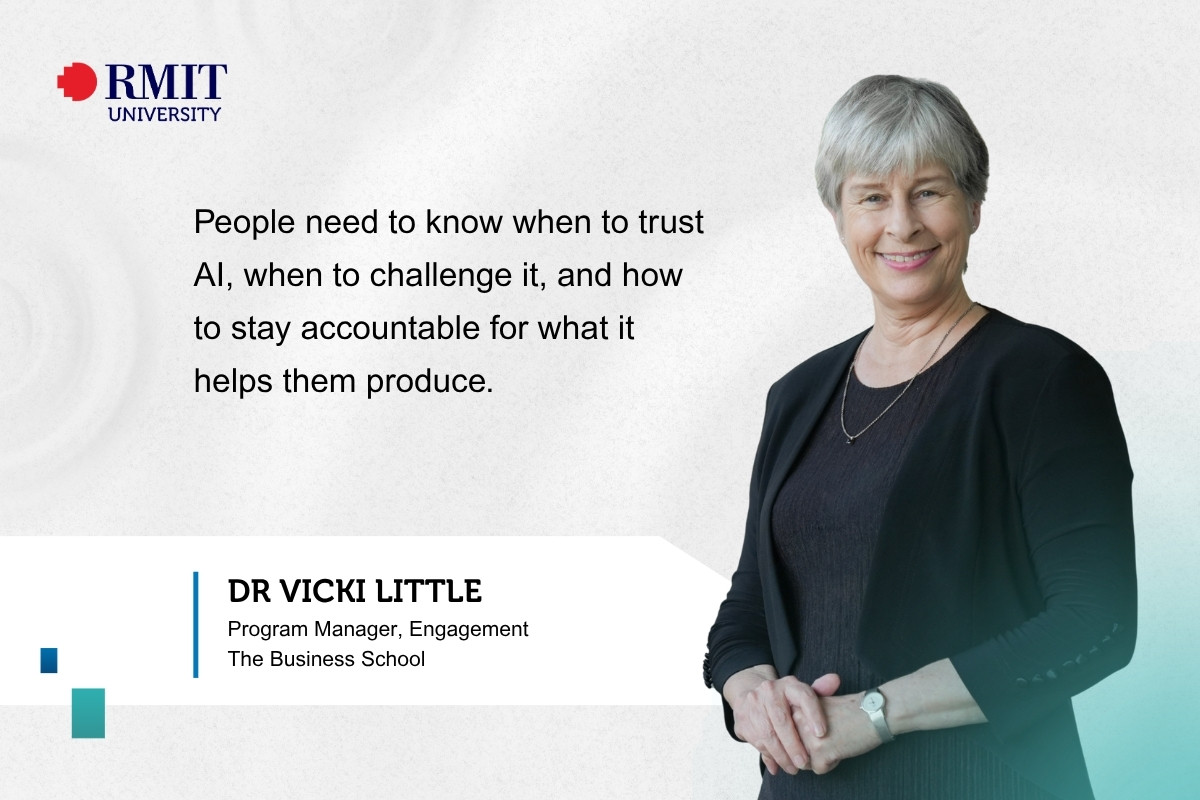
“People need to know when to trust AI, when to challenge it, and how to stay accountable for what it helps them produce,” Dr Little says.

“AI exerts a multiplier effect – experts become more expert, and on the other hand, less AI-literate people become more vulnerable. In an age of information over-abundance and wisdom scarcity, human judgement is more important, not less.”

Dr Vicki Little next to her quote: “People need to know when to trust AI, when to challenge it, and how to stay accountable for what it helps them produce."

The future of knowledge work

Looking ahead, Dr Little is investigating how AI is changing knowledge systems and how humans and AI can together think differently about complex challenges like social inequality, climate change, and ageing populations.

As AI becomes more capable, the important question is what humans choose to do with it.

“This isn't just another technology cycle. AI is changing how we think, not just what we produce. The challenge is deciding what kind of thinkers we want to become,” Dr Little says.

“Our best strategy is to stay curious, stay critical, and remember that wisdom has always been a profoundly human attribute.”

Behind every major shift is a story worth exploring. The Ripple Theory is a series of expert perspectives informed by research from RMIT University Vietnam. By connecting academic insight with real-world stories, the series helps readers gain a deeper understanding of the shifts unfolding across the economy, society, environment, and technological world, while exploring solutions and opportunities for what lies ahead.

Story: Ngoc Hoang

Related news