Why some AI service apps win trust while others fail

Why some AI service apps win trust while others fail

AI-powered service apps promise convenience, yet many struggle to retain users. RMIT Vietnam research reveals why authenticity, not intelligence alone, keeps people coming back.

We’ve all done it: closed a customer service chatbot in frustration or questioned whether an app was really helping us or simply trying to sell us something.

AI-powered apps are becoming commonplace in banking, healthcare, retail and customer support as organisations are investing heavily in the technology. Yet many users stop using these services almost as quickly as they adopt them.

Research by Dr Diem-Trang Vo, a lecturer in Professional Communication at RMIT University Vietnam, suggests the deciding factor is often not how intelligent an AI service is, but how authentic it feels to users.

Her research focuses on AI-powered service apps developed by organisations to interact with customers. Unlike multi-functional AI tools such as ChatGPT or Gemini, these apps are designed to support specific services and directly assist customers with tasks and enquiries.

“I began this research in 2021, when AI in everyday services was still mostly limited to chatbots and recommendation systems,” Dr Trang says.

“At the time, many companies were excited to promote these AI features as evidence that they were innovative. But from a user’s perspective, the experience was often frustrating. Chatbots frequently couldn’t answer questions, redirected people back to websites, or simply created more work instead of making life easier.”

Two hands holding a smartphone with an app open on it.AI-powered service apps are becoming commonplace in banking, healthcare, retail and customer support. (Photo: Magnific)

That experience led her to ask a question: does adding AI automatically make a brand better, or does it first need to feel authentic to users?

The question is especially timely for Vietnam, where AI is increasingly embedded in both the private and public sectors.

“Their heavy investments in digital transformation and AI present an exciting opportunity,” Dr Trang says. “However, the conversation often focuses on building the most advanced technology rather than asking whether that technology actually serves the people who use it.”

Why users abandon AI service apps

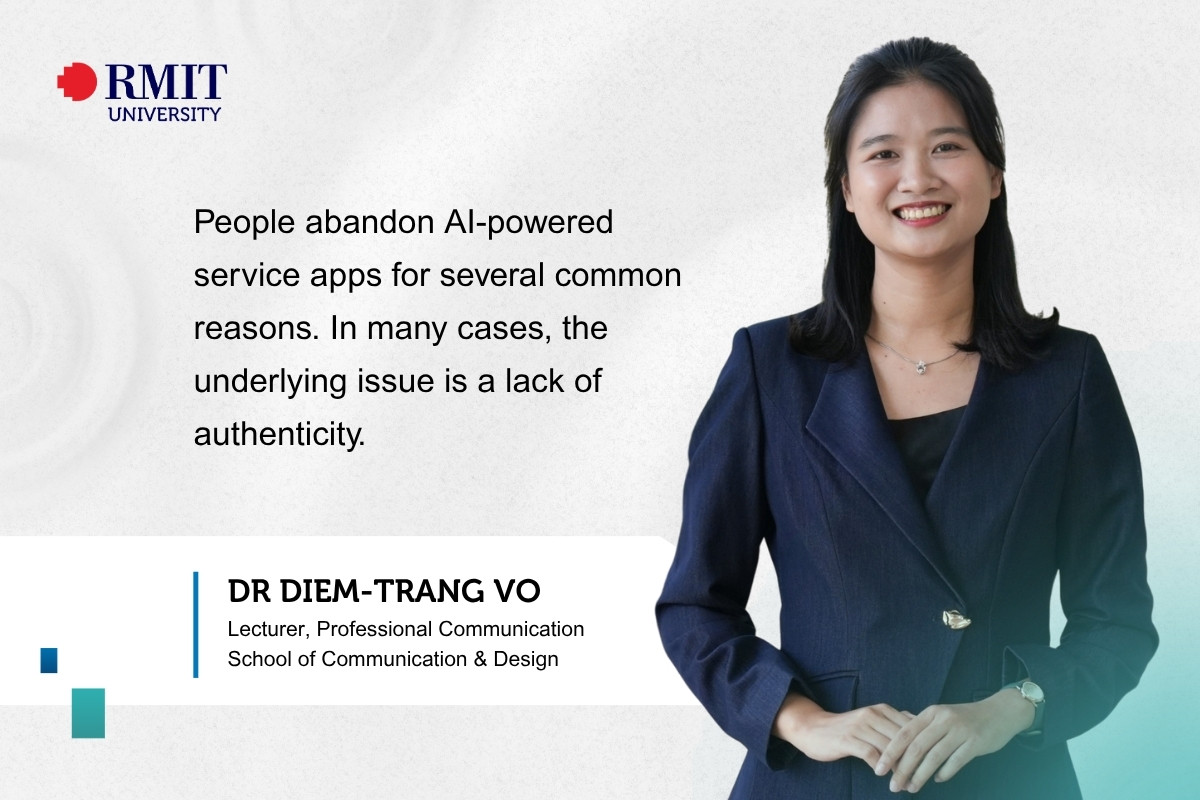
According to Dr Trang's research, people abandon AI-powered service apps for several common reasons. In many cases, the underlying issue is a lack of authenticity.

The research found that users judge authenticity through four dimensions: whether people believe the brand genuinely wants to help them (sincerity), whether the AI interaction feels real and socially engaging (social presence), whether the information is trustworthy (credibility), and whether using the app helps people feel understood and aligned with who they are (symbolism).

When those expectations are not met, users quickly lose trust.

One major trigger is monetisation that feels exploitative. “Users told us that kind of thing signals the company cares about profit more than about them,” Dr Trang says, referring to experiences such as intrusive advertising or being forced to pay before receiving meaningful assistance.

Trust also erodes quickly when apps are unreliable. “It's interesting because good functionality does not win an app much credit, but bad functionality damages trust almost immediately,” she says.

Users can also become sceptical when AI systems cannot explain their recommendations, provide inconsistent answers, or fail to account for local contexts and cultural differences.

Perhaps most importantly, emotional safety plays a critical role. “If people don't feel safe disclosing something personal, especially around health or body image, they leave, and that mattered more than almost anything else we measured.”

These judgements have important consequences. Users who perceive an AI-powered service as authentic are significantly more likely to continue using it over time.


Dr Trang Vo next to a quote saying: "People abandon AI-powered service apps for several common reasons. In many cases, the underlying issue is a lack of authenticity."

Building AI people want to use

For businesses, the findings challenge a common assumption that better AI simply means more advanced AI.

“The biggest lesson is that businesses shouldn’t focus only on making AI smarter, they should focus on making it feel authentic,” Dr Trang says.

“Our research shows that people stay with AI-powered apps when they believe the app genuinely serves their interests, rather than trying to maximise sales or engagement.”

She also cautions against replacing human support entirely.

“Our findings suggest that responsive, capable human support remains an important signal of authenticity. It shows customers that the business recognises not every situation can or should be standardised by AI.”

Transparency, fair monetisation practices, culturally relevant recommendations, and clear explanations of how recommendations are generated all help strengthen authenticity perception, which then leads to trust, purchase intention or value co-creation intention. Just as importantly, businesses should create environments where users feel respected and comfortable sharing personal information.

For consumers, Dr Trang believes the next important digital skill will be learning how to recognise authentic AI.

“As AI becomes part of everyday life, the most valuable skill will not be knowing how AI works, it will be knowing which AI systems genuinely deserve our trust.”

Behind every major shift is a story worth exploring. The Ripple Theory is a series of expert perspectives informed by research from RMIT University Vietnam. By connecting academic insight with real-world stories, the series helps readers gain a deeper understanding of the shifts unfolding across the economy, society, environment, and technological world, while exploring solutions and opportunities for what lies ahead.

Story: Ngoc Hoang

Thumbnail image: stock.adobe.com

Related news