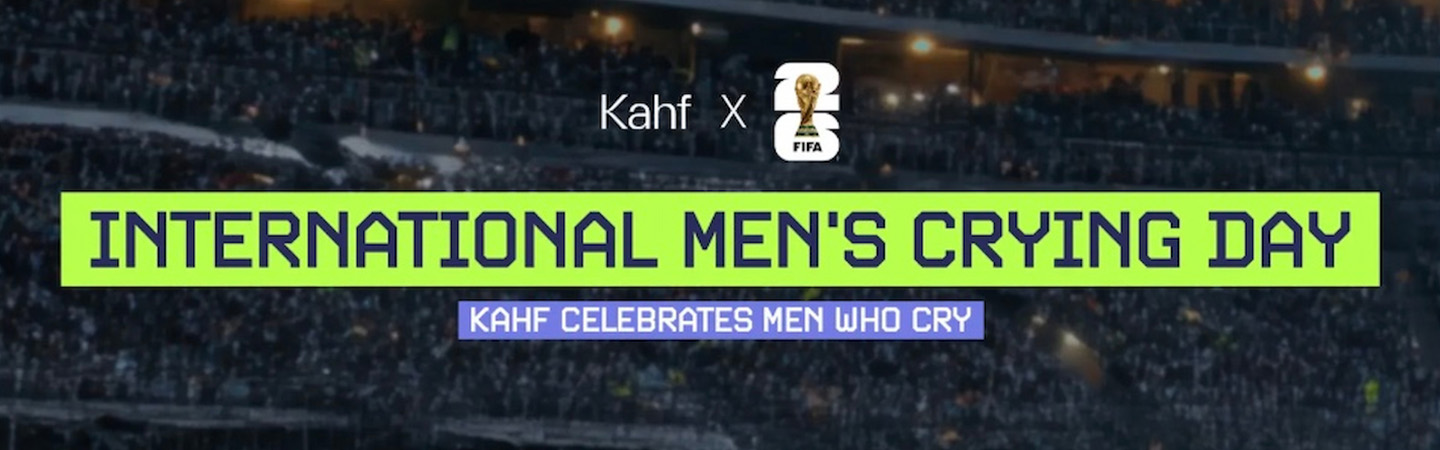
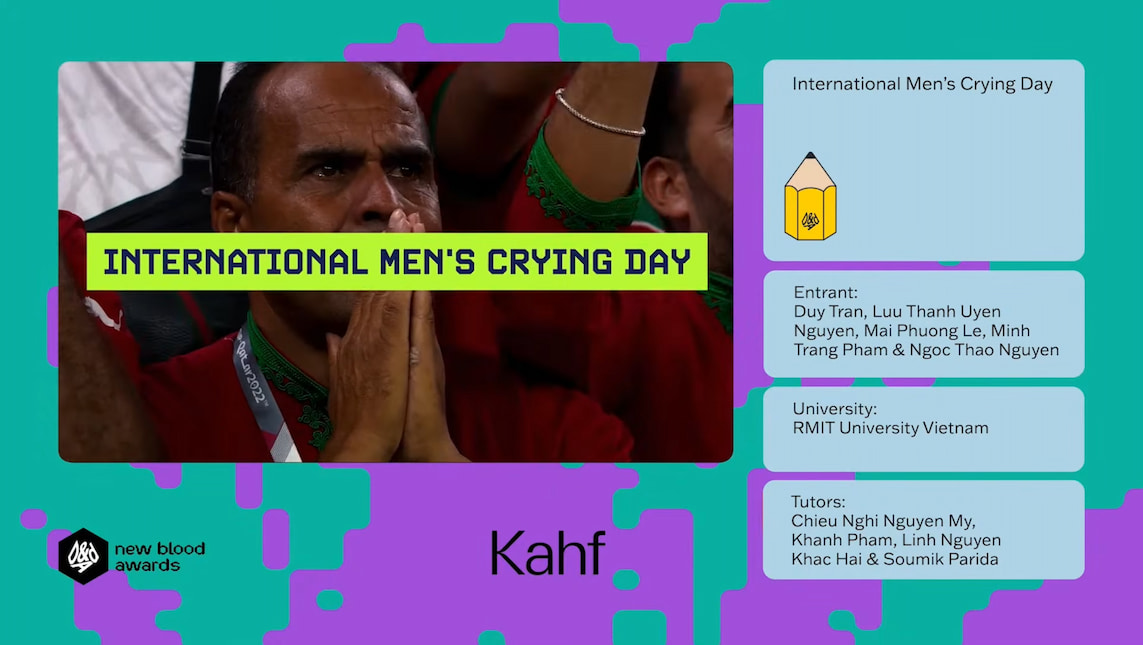
The campaign centres on a simple but powerful insight: while society often tells men not to cry, the FIFA World Cup final is one of the few places where men openly express their emotions.
“Masculinity has long been shaped by one unspoken rule: men don't cry. It's not because they lack emotion, but because the world judges them for it,” the team explained in their campaign.
“There is a paradox here: the place most associated with masculinity is also where men cry the most. That place is the World Cup stadium.”
Building on that insight, the team proposed partnering with the FIFA World Cup 2026 to transform the final into International Men's Crying Day, reframing tears not as weakness but as a symbol of courage, authenticity and modern masculinity.
The campaign proposed a range of ideas, including a “Crying cam” that captures emotional moments of male fans and broadcasts them on the stadium's big screen during the World Cup final. It also included a branded gift set featuring a sweatband carrying the message “Celebrate men who cry”, together with a facial cleanser and football trading cards, all supported by an integrated campaign spanning out-of-home advertising, point-of-sale materials (POSM), and social media.
For team member Tran Duy, finding the right idea required looking beyond simply answering the brief.
“We began by exploring a wide range of D&AD briefs, breaking each one down into its core objectives to understand what every brand was truly asking for,” Duy said.
“After discussions with our lecturers in the Creative Competitions course, we chose the brief that resonated with us the most, one where we believed our ideas could create meaningful value rather than simply answer the challenge.”
The team then immersed themselves in understanding the brand, its context and audience before uncovering the human insight that became the foundation of the campaign.
Like many successful creative ideas, however, the winning concept emerged only after countless rejected ones. “Our biggest challenge was the endless process of discarding and refining ideas to find the perfect one,” the team said.
“Every rejected idea built up immense pressure. It felt like we were failing every single time, even making us question whether we were creative at all.”
Despite the setbacks, the team continued pushing forward with support from one another, as well as lecturers and mentors. “Even the smallest words of encouragement kept us going. This journey was truly life-changing and has opened many doors for us, and we feel deeply appreciated.”