
Emerging Technologies in Education

About the Emerging Technologies in Education cluster

The Emerging Technologies in Education research cluster, within the School of Science, Engineering & Technology, explores how technology intersects with pedagogical innovation. Our interdisciplinary research focuses on leveraging advanced technologies such as artificial intelligence (AI), interactive teaching tools and learning analytics to improve student learning outcomes and enhance engagement. We address key challenges, such as creating active and engaging learning environments personalised to meet each student’s needs, using data-driven insights to inform and improve instructional design and integrating industry-based learning opportunities to better prepare students for real-world careers. Our work bridges theory and practice, providing actionable insights for educators and contributing to the growing field of technology-enhanced learning. Building on these insights, our research extends beyond the RMIT community through a range of projects and initiatives that collaborate with local educators and schools. By sharing cutting-edge research and innovation, and providing training to local educators and teachers, the cluster helps empower them to adapt to new teaching methods that better meet the specific needs of students in Vietnam, contributing to the technological and educational transformation of the country.

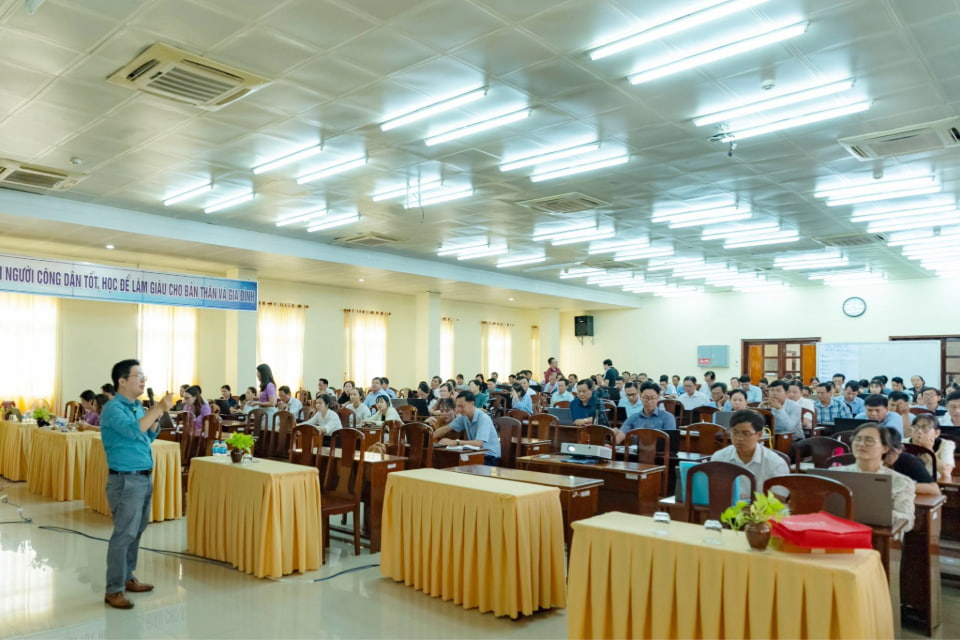
Photo of a classroom overlaying with digital data graphics, illustrating the merging of technology and education.

Key themes

  • Technology-enhanced learning design: explores emerging technologies such as AI, VR/AR, and interactive tools to optimize instructional design across K-12 and higher education. 
  • Empowering educators with AI: studies how AI and modern technologies build teacher competencies and professional development across K-12 and higher education. 
  • Student engagement and digital wellbeing: examines how technology shapes student attention, engagement, and wellbeing. 

Notable events

Photo of a speaker presents to a large audience in a well-lit conference room in Vietnam filled with attentive participants seated at tables.

Empowering Educators With AI: A Nationwide Transformative Initiative for Vietnam

This project is funded by the Strategic Innovation Challenge Round 2. It aims to revolutionize education in Vietnam by implementing a comprehensive training program on advanced AI technologies and associated pedagogical approaches for educators.

The researchers from the cluster delivered the first official nationwide AI training programme for over 350,000 Vietnamese K–12 teachers and education administrators in 2025 in collaboration with MOET. This culminated in the Vietnam Education Festival on AI and Digital Innovation 2025, which drew more than 700 educators and administrators in person plus almost 44,000 teachers online, and featured 49 top AI-powered products alongside a technology exhibition, specialist seminars and panel discussions.

By equipping teachers nationwide with practical AI skills, the project advances Vietnam's digital transformation in education and strengthens the country's AI capabilities 
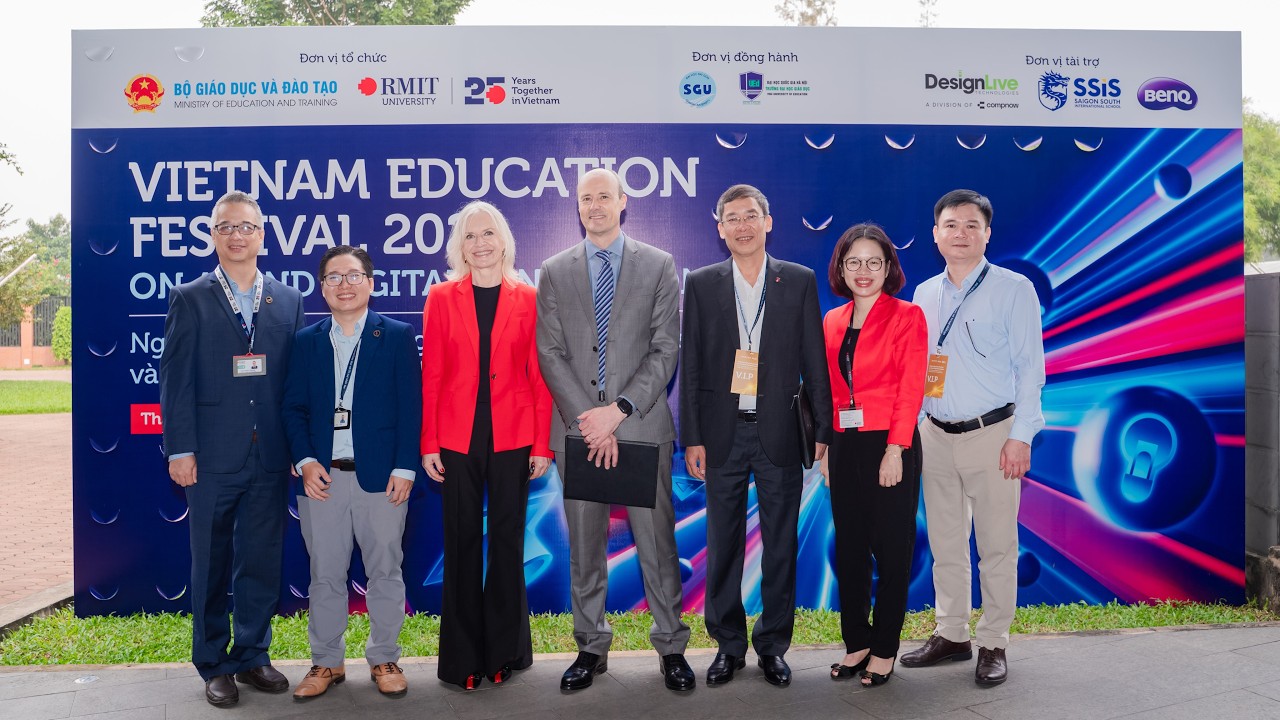
EduFest 2025 - Vietnam Education Festival on AI and Digital Innovation highlights | RMIT Vietnam

Key publications

  • Pham, T., Nguyen, T. B., Ha, S., & Nguyen Ngoc, N. T. (2023). Digital transformation in engineering education: Exploring the potential of AI-assisted learning. Australasian Journal of Educational Technology, 39(5), 1–19. https://doi.org/10.14742/ajet.8825
  • Ngoc Tran, Q., Nguyen, T. N., Pham, T., Felipe, A., Huynh, T., Tran, Q. N., Abdul-Nour, G., Ngoc Dinh, M., Seecharan, T., Crespo Márquez, A., Komljenovic, D., Amadi-Echendu, J., & Mathew, J. (2024). Assessment design before and after the emergence of generative AI. 17th WCEAM Proceedings. ISBN: 978-3-031-59042-9
  • Pham, T., Tran, M., Kavalchuk, I., Nguyen, T. N., Abdul-Nour, G., Ngoc Dinh, M., Seecharan, T., Crespo Márquez, A., Komljenovic, D., Amadi-Echendu, J., & Mathew, J. (2024). Digital transformation in higher education with support from large language models: A multiple perspective approach to teaching engineering courses. 17th WCEAM Proceedings. ISBN: 978-3-031-59042-9
  • Felipe, A. L., Pham, T. C., Amouroux, E., & Nguyen, M. X. (2017, December 13). Interdisciplinary collaborative teaching in project-based learning approach. In 28th Annual Conference of the Australasian Association for Engineering Education (AAEE2017). ISBN: 9780646980263
  • Tran, L. D., Tung, N., Macalinga, E. T., Tang, A., Woo, B., & Tam, W. (2024). Visual narratives in nursing education: A generative artificial intelligence approach. Nurse Education in Practice. https://doi.org/10.1016/j.nepr.2024.104079
  • Dang, T. T., Ling, H.-C., & Tran, N. Q. (2024). Combating ChatGPT-based programming test cheating — An evaluation using public problems. In 2024 6th International Conference on Computer Science and Technologies in Education (CSTE) (pp. 161-165). Xi'an, China. https://doi.org/10.1109/CSTE62025.2024.00037
  • Felipe, A. L., Pham, T. C., Amouroux, E., & Nguyen, M. X. (2017). Interdisciplinary collaborative teaching in project-based learning approach. 28th Annual Conference of the Australasian Association for Engineering Education (AAEE 2017). https://search.informit.org/doi/10.3316/informit.384931311258616
  • Felipe, A. L., Amouroux, E., Pham, T., & Stojcevski, A. (2016). Vietnamese students' awareness towards a project-based learning environment. 8th International Symposium on Project Approaches in Engineering Education/14th Active Learning in Engineering Education Workshop.
  • Eleazar, M., Aragoncillo, A., Nguyen, M. X., & Felipe, A. L. (2020). Bringing PBL to Philippines' higher education: How much are teachers geared for the transition from traditional to PBL approach? International Symposium on Project Approaches in Engineering Education. EID: 2-s2.0-85090844210. ISSN: 21831378

Cluster lead

Dr. Thanh Pham, Lecturer

Dr. Thanh Pham has been a lecturer in Electronic and Computer Systems Engineering at RMIT University in Vietnam since 2011. His research interests include microelectronic engineering, technological education, project-based learning and applying generative AI (GenAI) to education and healthcare. As an experienced researcher, Thanh focuses on innovative learning and teaching strategies for higher education, with published work in project-based learning and interdisciplinary collaborative teaching.

His recent research explores the benefits and challenges of integrating generative AI into engineering education programs. Thanh also has extensive experience teaching STEAM courses at both the higher education and K-12 levels in Vietnam. In addition, he has designed and led STEAM training programs for K-12 teachers, equipping them to implement innovative, hands-on teaching strategies in their classrooms.

Photo of RMIT academic staffDr. Thanh Pham, Electronic and Computer Systems Engineering lecturer

Cluster members

Associate members

PhD students

  • Tran Tien An
  • Thanh Vo
  • Nguyen Thi Ty
  • Tung Nguyen
hands on a laptop on a wooden desk with stylish accents, a wallet and mobile phone beside the user.

Pursue a Graduate research degree at RMIT

RMIT offers fully funded scholarships (full tuition and a stipend of 14 million VND per month) for Vietnam based PhD candidates who fulfill the scholarship eligibility requirements, subject to availability of funding.

Contact our research team

Explore other research clusters