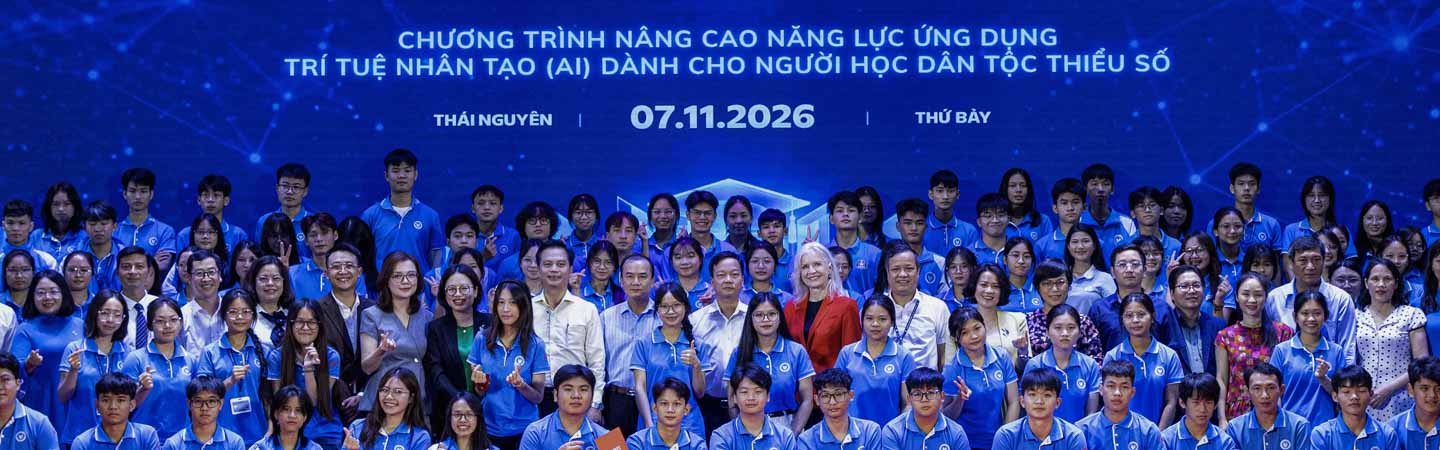
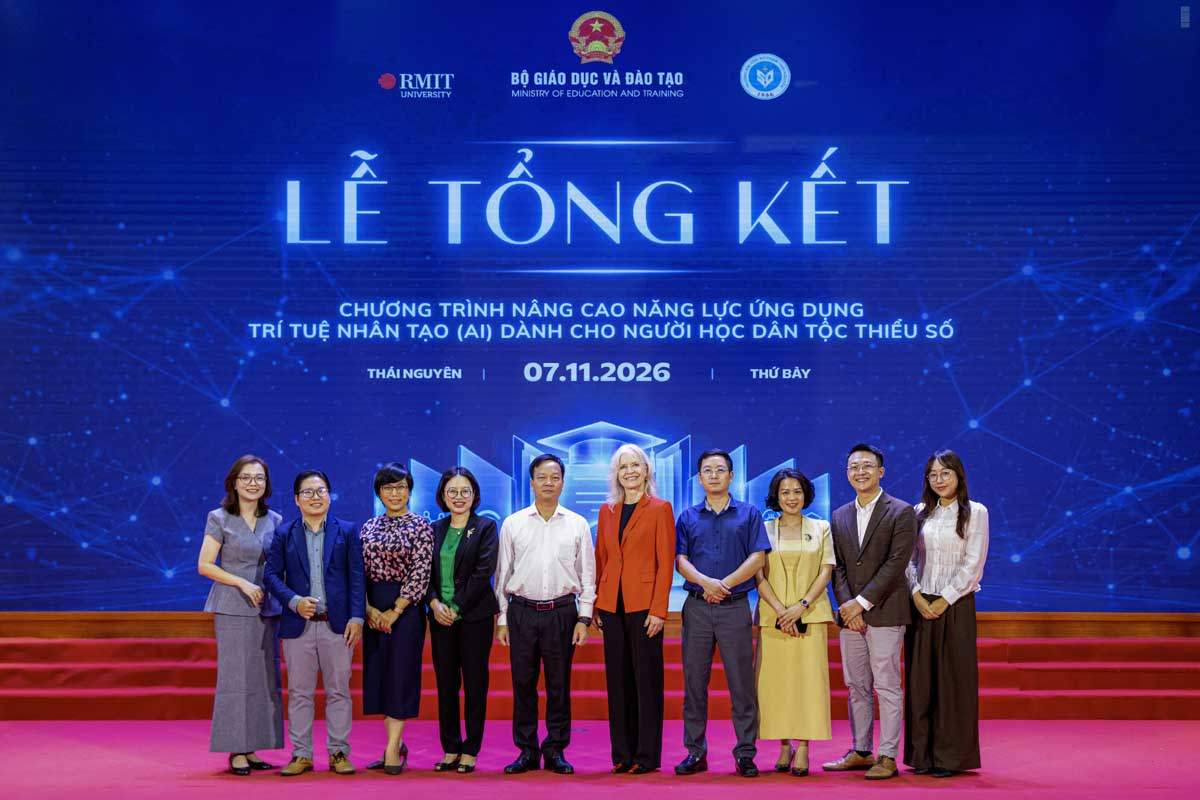
The training program was launched on 17 October 2026 at Da Lat University and concluded on 07 November 2026 at Thai Nguyen University of Education, following six hands-on training sessions delivered through a combination of in-person and online activities.
Across eight participating higher education institutions – including Thai Nguyen University (including four-member universities: University of Education, branch campuses at Ha Giang, Lao Cai, Dien Bien), Dalat University, Dong Thap University, Tan Trao University, Tay Bac University, Tay Nguyen University, Tra Vinh University, and Vinh Medical University – the program empowered more than 5,400 ethnic minority students to build practical digital capabilities and gain confidence in adopting artificial intelligence for their studies and future careers.
The live classes drew more than 38,900 views and nearly 24,200 study interactions across the program’s online platforms, as students took part in class activities and shared ideas. The program brought together students from more than 40 ethnic minority groups, and nearly three in four participants were women.
Grounded in MOET’s Digital Competency Framework for Learners and referencing UNESCO’s 2024 AI Competency Framework for Students, the curriculum was designed by Dr Linh Tran and Dr Thanh Pham, lecturers from RMIT Vietnam’s School of Science, Engineering & Technology (SSET). Custom-built, inclusive and tailored to its audience, the program covered essential topics for the AI era, including AI agents and automation, Digital safety awareness and cybersecurity, AI professional skills for graduates, including career planning, CV development, and mock interviews. With more than 11,000 feedback responses, students rated the sessions 4.8 out of 5 on average.
Education driven by action and community impact
In his speech at the closing ceremony, Professor Dr Nguyen Anh Dung, Deputy Director of Higher Education Department, Ministry of Education and Training, congratulated more than 5,400 students on successfully completing the program.
He praised their confidence and highlighted the value of equipping ethnic minority students with emerging technologies. The program has shown that when given the right access opportunities, ethnic minority students can shine.
Professor Iwona Miliszewska, Dean of the School of Science, Engineering & Technology at RMIT University Vietnam, commended the collaboration between MOET, RMIT, and partner universities: "At RMIT, our Knowledge with Action strategy reflects our belief that education and innovation should lead to meaningful outcomes beyond the classroom. This program brings that belief to life. It demonstrates the importance of responsible technology education, inclusive opportunity and strong partnerships between government, universities and communities."
Reflecting on the students' journey, Professor Miliszewska said: "Across the six training sessions, we were inspired by the students' enthusiasm, thoughtful questions and willingness to experiment. Many of them did not simply learn about AI; they explored how it could be applied to the needs of their own communities."
Turning new capabilities into practical community solutions
In addition to the training, the program encouraged students to innovate through the Student AI Challenge. Students from 10 campuses submitted 144 projects on topics ranging from ethnic languages, cultural heritage and hometown tourism to classroom teaching tools, farming, healthcare, online safety and career preparation. Many drew on their own communities, such as travel guides to their home provinces, an app for learning Khmer, and a digital home for Thai language and stories.
K’Diem, a Social Work student at Dalat University, shared what the program meant to her: “We understand that this opportunity is not only for ourselves. It is something we carry with us to share with our families, our home villages and our ethnic minority communities, because we believe that when knowledge is passed on, good values continue to grow and multiply.”
Recordings of the program's training sessions are available through the training video playlist. Students are also encouraged to stay connected, share ideas, and continue learning through the program's community.