Developed jointly by the Department of Teachers and Education Administrators under Vietnam’s Ministry of Education and Training (MOET) and RMIT University Vietnam, with support from the Aus4Skills program, the AI Handbook for Educators aims to help educators and education leaders navigate the rapidly evolving world of artificial intelligence (AI) while maintaining human oversight, pedagogical judgement, learner wellbeing and ethical responsibility.
This handbook draws on recognised Vietnamese and international guidance, competency frameworks and resources on digital transformation, digital competence and AI in education. These include the MOET's digital competence frameworks, UNESCO's AI competency frameworks for teachers and students, and relevant reports and recommendations from the OECD and other international education organisations.
As AI tools become increasingly common in classrooms and workplaces, educators are exploring new ways to find and analyse information, plan lessons, create assessments, develop learning resources, provide feedback, manage classrooms and support their own professional learning. At the same time, many are grappling with questions around factchecking, personal data protection, equity, copyright, and the educator’s professional role.
The handbook was created to address these challenges by providing practical, accessible guidance that educators can apply in their day-to-day work. Rather than focusing on technical concepts, it takes a hands-on approach, helping educators understand how AI can be used purposefully to enhance learning outcomes and improve productivity, and support effective teaching practice.
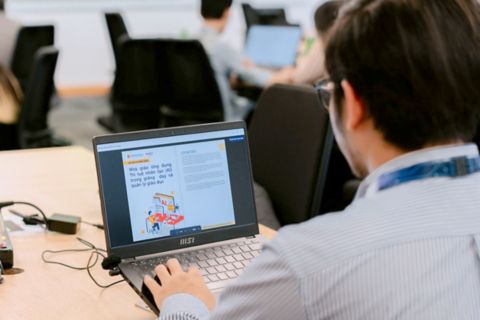
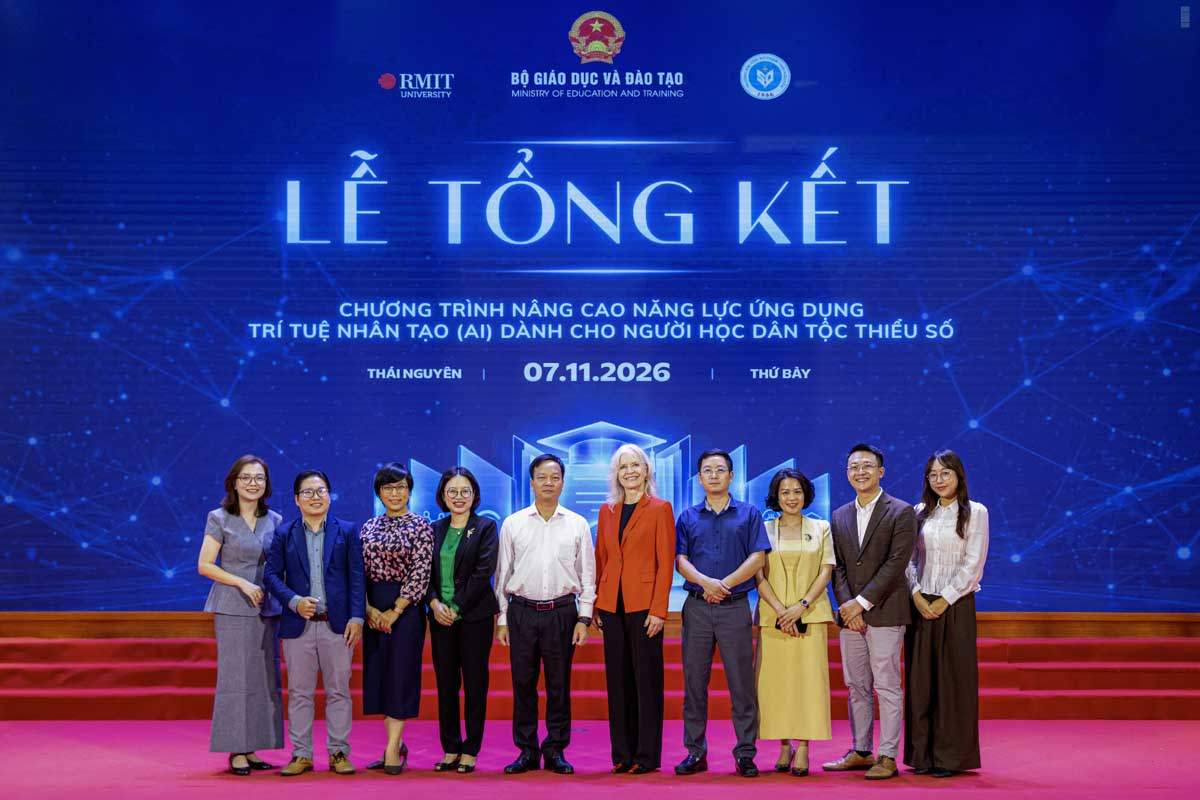
The handbook was recently launched, officially handed over to MOET, and adopted for use in the 2026 training program on "Applying artificial intelligence (AI) in teaching and management for vocational education educators", jointly implemented by Department of Teachers and Education Administrators and RMIT Vietnam.
Dr Vu Minh Duc, Director General of the Department of Teachers and Educational Administrators, MOET, stated that the effective application of AI is a key factor in enhancing training quality, helping learners readily adapt to the stringent demands of the labour market in the digital era.
“The e-handbook serves as a practical guide, providing methodological suggestions, standardised prompts and visual tools for teachers to reference and regularly apply in their daily teaching,” Dr Duc said.
The handbook is organised into six themes that guide readers from foundational AI literacy to practical applications. These cover effective and responsible AI use, lesson planning and teaching presentations, assessment design, digital learning resource development, learning support, school administration, and educators’ professional growth in the AI age.
Throughout the resource, educators are provided with practical examples, sample prompts and real-world scenarios that demonstrate how AI can support everyday tasks. The handbook also encourages critical evaluation of AI-generated content and highlights the importance of academic integrity, privacy protection and professional judgement.
According to Dr Tran Duc Linh, the project team’s representative, one of the handbook’s key messages is that AI should be viewed as a tool to support educators rather than replace them. While the technology can help streamline routine tasks and generate ideas and improve efficiency, educators remain responsible for guiding learners, making informed decisions and creating meaningful learning experiences.
The launch forms part of the broader work of the Empowering Educators with AI (EEAI) initiative, which aims to advance AI-powered education in Vietnam and contribute to the global learning community. By equipping educators with the knowledge, tools and confidence to engage with AI, the handbook seeks to support innovation in teaching and learning while helping education institutions prepare for the future.
The AI Handbook for Educators is available online and free to access for educators and education leaders across all school levels, from early childhood to general education.
Story: Ha Hoang