RMIT explores the human edge in AI-enabled higher education

RMIT explores the human edge in AI-enabled higher education

Higher Education Horizons 2026 brought educators, researchers and industry leaders together at RMIT Vietnam to explore how AI can enhance education while preserving human potential.

Artificial intelligence (AI) is rapidly reshaping how universities teach, learn and assess, but how can higher education harness new technologies while preserving the human capabilities that matter most? 

This question was at the heart of Higher Education Horizons 2026 – The Human Edge, held at RMIT University Vietnam. 

Now in its third iteration, the symposium brought together over 250 educators, researchers, learning designers, institutional leaders, industry partners and students from across Vietnam and the wider Asia-Pacific region to explore emerging approaches to teaching, learning, assessment and educational design in an AI-enabled world. 

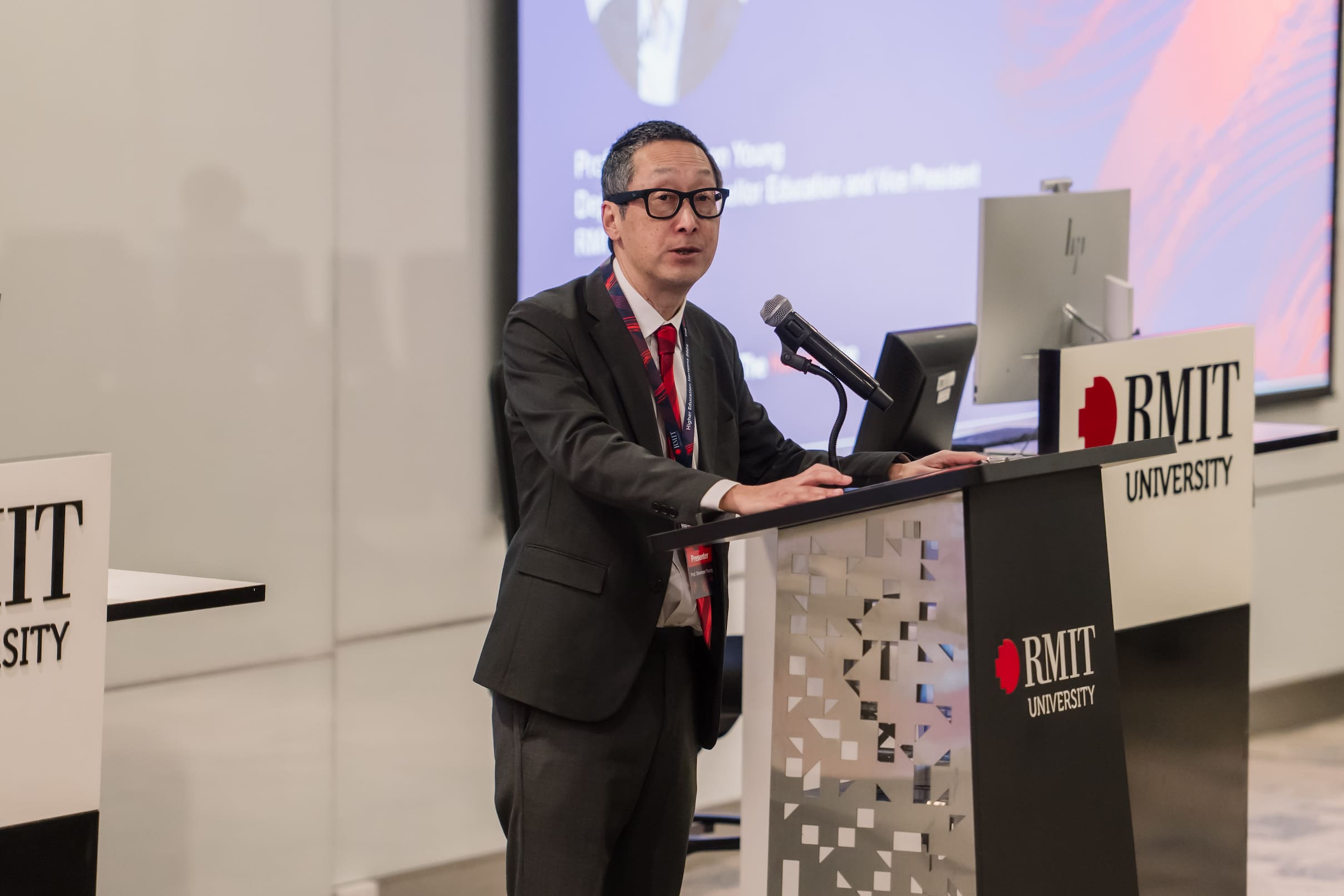
In his welcome remarks, Professor Sherman Young, Deputy Vice-Chancellor Education and Vice-President at RMIT, said the growing role of AI in higher education raised important questions about institutional responsibility, including how universities shape its use, the knowledge and judgement they cultivate, and how AI can expand rather than narrow educational possibilities.

Professor Sherman Young (RMIT University)  Professor Sherman Young (RMIT University)

Professor Young said: “The human edge is not about a competition between people and machines. Rather it points to our capacity to determine purpose, exercise sound academic judgement, act ethically, care for others and accept responsibility for our decisions. AI may support these capacities, but it does not relieve us of them.” 

At RMIT, this approach is reflected in its Knowledge with Action philosophy and focus on preparing AI-ready graduates while retaining a commitment to active, applied and authentic learning. RMIT's Generative AI Lab for Education (GAILE) takes a human-centred, pedagogy-led approach to AI, focusing on building capability for AI, enhancing education with AI and developing critical understanding about AI. 

The University has also developed a Generative AI Skills Continuum as a shared framework for appropriate AI use. At RMIT Vietnam, the four Ds – Delegation, Description, Discernment and Diligence – help staff and students consider what should be delegated to AI, how its contribution should be described, how its outputs should be assessed and how responsibility for its use should be maintained. 

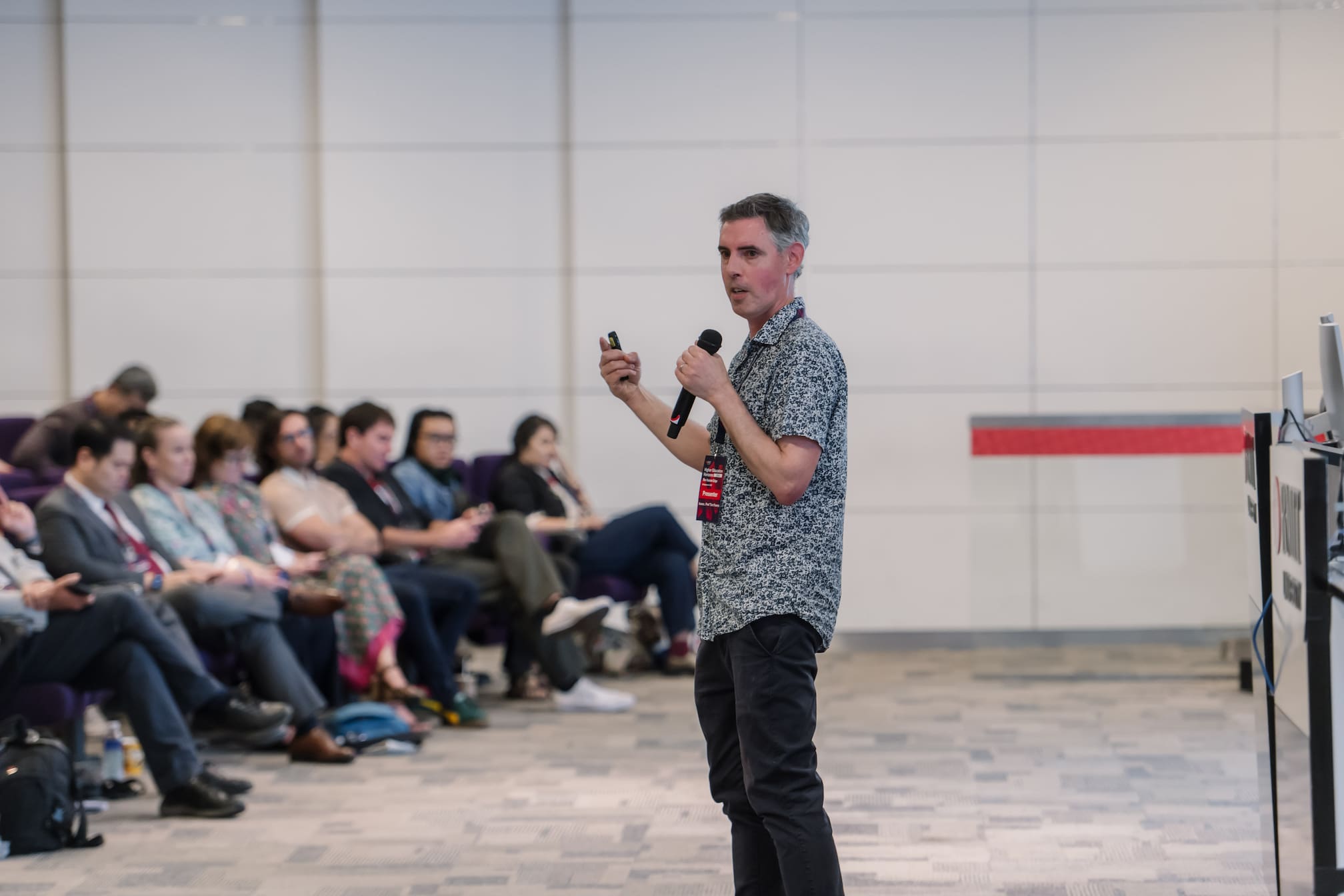
Associate Professor Tim Fawns at the Monash Education Academy, Monash University, delivered the keynote presentation titled: “Designing entangled humans: tensions of agency, authenticity and architecture in education.” 

Associate Professor Tim Fawns (Monash University) Associate Professor Tim Fawns (Monash University)

Associate Professor Fawns argued that AI should not be treated as the sole driver of educational change, with learning shaped by the interaction between technology, educators, students, values and context. He urged universities to keep educational purpose and values in focus while designing for student agency in an uncertain future. 

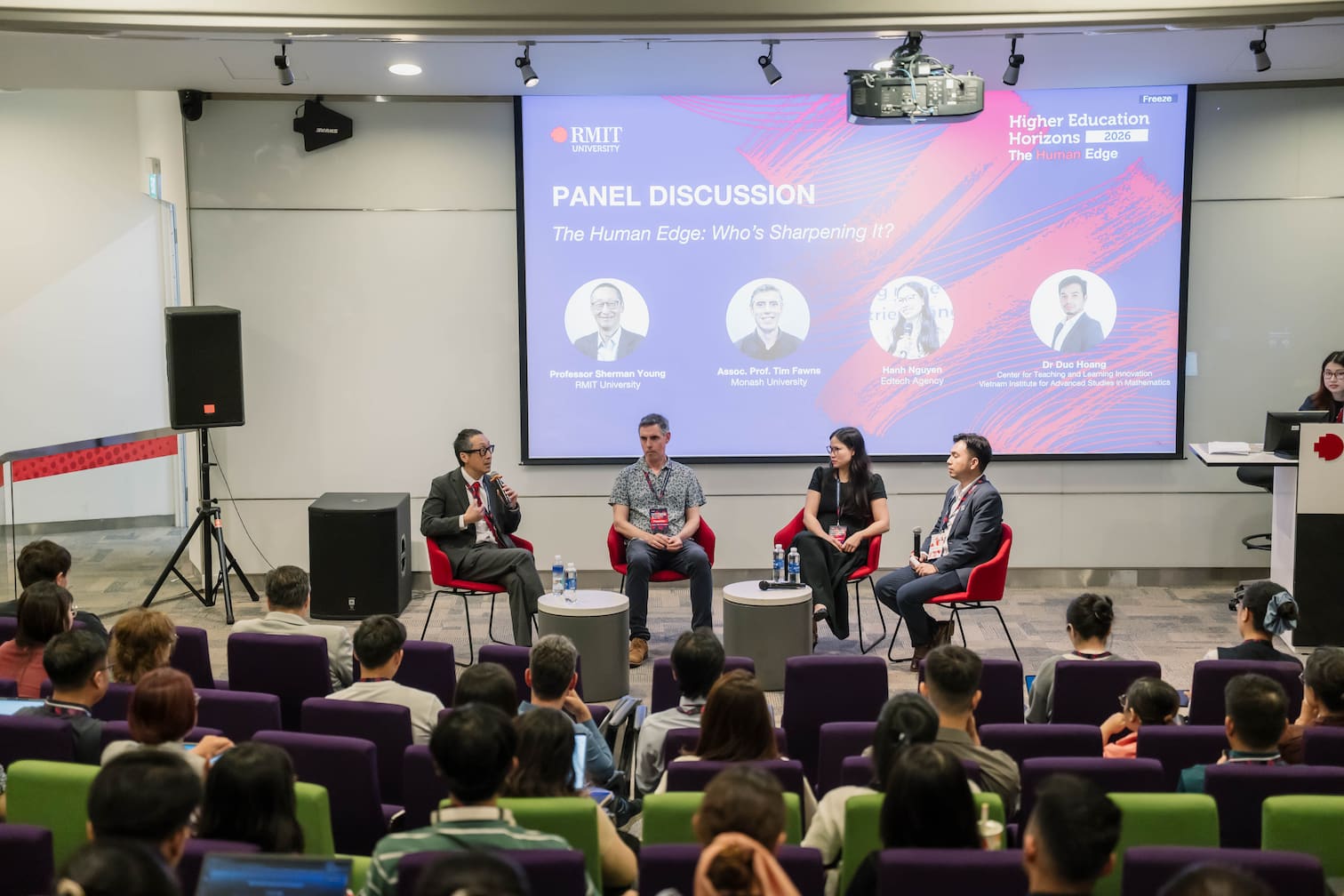
The symposium also featured the panel discussion “The human edge: Who's sharpening it?”, bringing together perspectives from Professor Sherman Young, Associate Professor Tim Fawns and Ms Nguyen Hong Hanh (Edtech Agency). The discussion was facilitated by RMIT research fellow Dr Hoang Anh Duc, Director of Center for Teaching and Learning Innovation, Vietnam Institute for Advanced Studies in Mathematics. 

Panellists highlighted the importance of preparing students not simply to use today's technologies, but to adapt as technologies, workplaces and career pathways continue to change. 

Associate Professor Fawns said universities should focus on developing students' capacity to navigate uncertainty and shape their future, rather than preparing them for a fixed set of skills. “That means they need to build adaptive capacity,” he said. 

Professor Young similarly emphasised the importance of helping students become adaptable. “We as educational institutions aren't in the business of teaching with a particular technology. We are there to enable our students to learn to use any technology,” he said. 

Associate Professor Fawns added that universities need to develop both practical technology skills and the ability to critically evaluate technologies as they change. “You need to teach this kind of meta level way of thinking about technology and how to be critical around it and how to evaluate what comes out of it,” he said. 

For Ms Hanh, the rapid pace of technological change makes it important for education providers to consider technology in context, taking into account institutional resources, teacher capability, existing systems and learners' needs. “We have to find a way to introduce the right thing for them, right with the budget, right with the current situation and technology,” she said.

The panel discussion brought together perspectives from higher education, research, policy and the EdTech sector. The panel discussion brought together perspectives from higher education, research, policy and the EdTech sector.

The panel also considered how universities can respond to changing expectations around education, work and lifelong learning. Rather than simply replacing established models with new ones, Associate Professor Fawns said higher education could expand the range of pathways available to learners while retaining approaches that continue to provide value. “It's not switching A for B but building out a richer tapestry of things,” he said. 

Professor Young said the changing education landscape also provided an opportunity to rethink traditional pathways from school to university and postgraduate study.  

“What the current environment is almost forcing us to do is to rethink our assumptions about everything,” he said, questioning whether the traditional model of K-12 education followed by undergraduate and postgraduate study would remain the right model for the future.  

“There are now far more options and the world of work and the world and life after education is far more complicated.” 

From an EdTech perspective, Ms Hanh noted that universities could increasingly serve as lifelong learning institutions, with learners returning for reskilling, upskilling and micro-credential programs as their needs evolve. 

The discussion returned to the role of human judgement as AI becomes increasingly capable. When asked what individuals should keep in mind as they return to work, Associate Professor Fawns offered a concise principle: “Let's not automate human judgement, because I think that might be a death spiral.” 

Professor Young said people also need to maintain a broader perspective as AI evolves rapidly. “We have to be able to step up and get a bigger picture,” he said. “This is different, but it's not a pattern that hasn't happened before and we should learn from history whilst applying that historical lens to the specifics of where we are now.” 

Professor Young said collaboration across the sector would be essential as institutions navigate the opportunities and challenges created by AI. “No one institution will resolve the questions surrounding AI and education alone,” he said. “This symposium is a space to learn from one another, test our assumptions and build collaborations across institutions, disciplines and sectors.” 

The conference also provided a platform for RMIT Vietnam to announce a new Centre of Excellence, designed to strengthen collaboration and knowledge exchange across three strategic streams: learning and teaching, digital futures, and English language education. 

Professor Seng Kok, Dean of Students at RMIT Vietnam, said: “As part of our vision for the next 25 years, we're launching a Centre of Excellence encompassing three streams that are strongly aligned with our mission in Vietnam, as well as Vietnam's ambitions for the future.” 

The Centre aims to bring together educators, researchers, industry partners and communities to explore emerging opportunities, develop new capabilities and create meaningful impact through collaboration. 

Story: June Pham

02 October 2026

Share

Related news