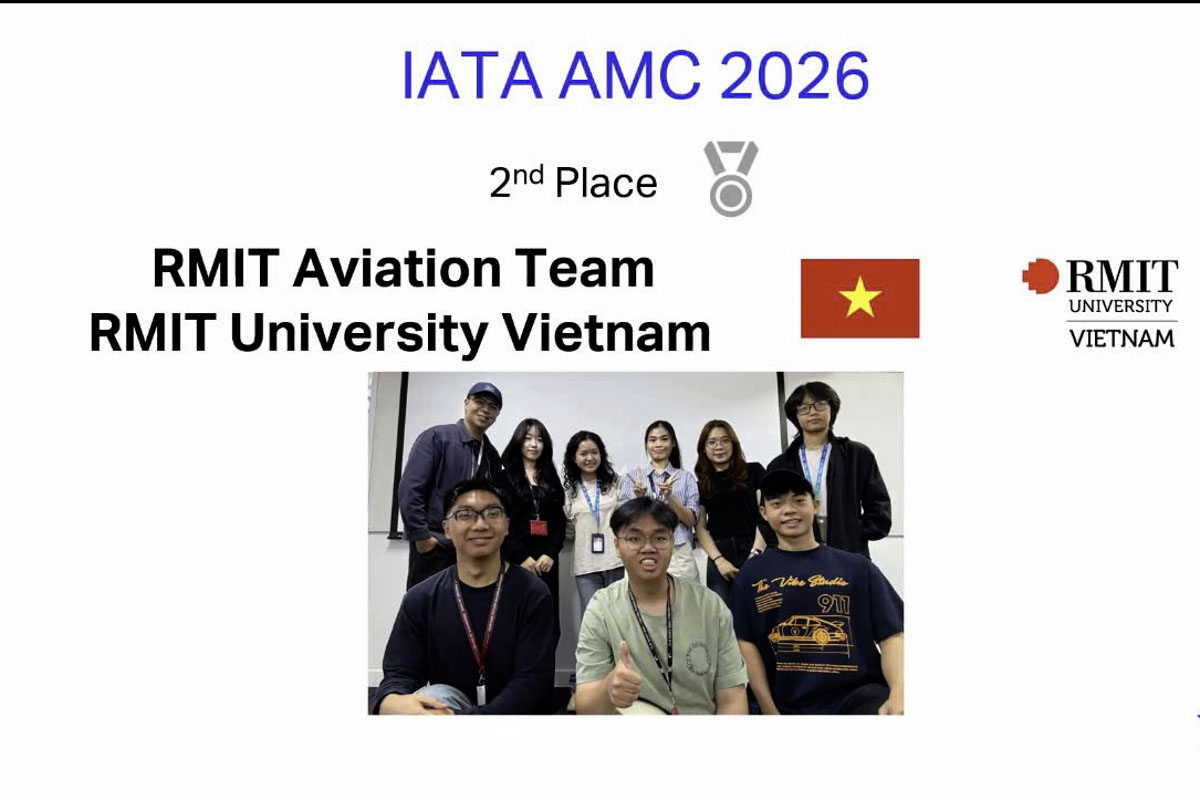
The journey began with a simple LinkedIn search the team leader Truong Vinh Minh Thu made after just three months at university.
“I really want to join but I need a team,” Thu said. With the support from the School of Science, Engineering & Technology (SSET), including outreach from her lecturer Dr Marco D'Alessandro, ten students and alumni came together to take on the competition.
The IATA Airline Management Challenge places participants in the role of airline executives, requiring them to manage routes, fleet allocation and pricing strategies across a simulated network. Using a business case involving five European destinations, teams must make decisions to maximise profitability over five rounds, including three regional and two global.
For RMIT Aviation Team, the first stages proved daunting.
“We had a lot of trouble understanding how to set ticket prices and predict passenger demand,” Thu said.
“At the beginning, we felt stressed and confused because everything was new and difficult.”
To overcome this, the team reorganised. They split into two groups, one focused on pricing, the other on fleet and route management, while working closely with each other to align decisions.
“Everyone was very committed,” Thu shared. “We shared ideas, fixed mistakes and supported each other every day.”
According to team member Do Ngoc Thuy Duong, the group quickly adopted a structured, analytical approach.
“We studied demand patterns, aircraft limitations, cost structures and market conditions,” Duong said. "After each round, we analysed indicators like load factor, breakeven levels and profitability by route to understand where we were performing well and where we were not.”
Rather than pursuing growth at all costs, the team refined a disciplined strategy focused on sustainable profit.
“It’s not about filling seats or adding more routes,” she said. “You need to balance revenue, cost and risk.”
The real challenge hit in the final round when fuel prices jumped 50 percent, threatening everyone’s bottom line. The sudden shift forced the team to rethink their entire approach.
“The fuel shock was the biggest challenge,” Thu said. "We realised our former strategy would not work anymore.”
Drawing on historical data and previous round reports, the team reorganised their network. They concentrated on profitable core routes, adjusted frequencies based on seasonal demand and aligned aircraft size with route performance – deploying larger aircraft on key routes while using smaller, more flexible planes for secondary markets.
“We didn’t just cut costs,” Thu explained. “We focused on smart pricing, timing and maintaining our market share. That helped us stay competitive.”
Behind the technical decisions was a strong team dynamic that helped sustain performance under pressure. Leading a group as a freshman was initially challenging for Thu, but she credited her teammates for their support.
“When I felt worried, they always told me not to stress, that this was a chance to learn,” she said. “Looking back, I feel very proud of what we achieved together.”
Dr Marco D'Alessandro, Interim Program Manager of Bachelor of Applied Science (Aviation) from RMIT Vietnam, said that the competition was not only an opportunity to test students’ knowledge in a realistic simulated environment, but also a chance to engage with like-minded, equally passionate colleagues in a fun, educational challenge.
“The IATA competition team was made up of students from different year levels: some contributed specialist knowledge, others brought enthusiasm and leadership, and some adapted and stepped into the roles that were needed throughout the competition, just as in real life,” he said.
For the RMIT Aviation Team, the competition offered more than a ranking. It provided hands-on insight into how airlines operate and how quickly conditions can change. It marked the beginning of how they see their future in the industry shaped by real decisions, real pressure and the confidence that they can handle both.
Story: Ha Hoang
Masthead image: Lukas Gojda – stock.adobe.com